Part One - Kariba
Part Two - Forest Inn
Day three (Sunday 20 Oct) dawned and after a few hours birding the Miombo Woodland around Forest Inn, we set off to drive the remaining 240km to our destination; Kasanka National Park, where we stayed for three nights.
 |
| Forest Inn to Kasanka National Park. At one point during the drive, we were just 1km from the border of the DRC. |
 |
Our travels inside Kasanka. Wasa Lodge is the main accommodation in the park, as well as the reception for camping.
Pontoon used to be an actual pontoon across the river, but now there's a bridge.
Fibwe Hide is the famous tree-top platform for viewing the bats in the evening. |
Kasanka National Park is dominated by pristine Miombo Woodland, with patches of Mushitu evergreen forest (this is where the bats roost). Many dambos (vleis) follow the rivers through the park, although these were mostly dried up in October when we visited. A few lakes and swamps are present.
At this point, the days were stinking hot, up to 39 degrees. This, plus the ever present swarms of biting flies, meant the windows stayed closed and the air conditioner on!
We camped at Pontoon campsite, on the edge of the Kasanka river in riparian forest - a beautiful spot.
I got a fairly impressive mammal list in the park - 12 species - despite it not being well known for its game. Bold species aren't found in Southern Africa.
Brown Greater Galago,
Yellow Baboon (ssp. kindae), Straw-coloured Fruit Bat,
Gambian Sun Squirrel, African Savannah Hare, an unidentified Genet sp, Side-striped Jackal, Hippopotamus, Common Warthog, Common Duiker, Puku, Bushbuck and Sitatunga.
Dambos, lakes and rivers: Puku were the most numerous mammal in the park, most of them in the open grassy areas of dambos and lake edges.
Warthog,
Yellow Baboon, Side-striped Jackal and African Savannah Hare were in the same habitat, the latter two only seen at night.
One Common Duiker was seen on the edge of a dambo.
Hippopotamus were in Wasa Lake (visible from Wasa Lodge).
 |
| Wasa Lake |
 |
| Typical dambo, dry during October. |
 |
| Common Duiker |
 |
| Puku female |
 |
| Puku male |
Miombo Woodlands: The woodlands were not very productive from a mammal watching point of view. Puku and
Yellow Baboon made up most of the sightings. Lichtenstein's Hartebeest occur but we never saw any. The Genet, which remains unidentified, was seen in the woodlands at night.
 |
| One of Zambia's largest trees, near Bufumu Forest |
 |
| Tall Miombo Woodland. Most of the park was similar to this. |
 |
| Yellow Baboon |
Riparian and Mushitu forest: The riparian forest around Pontoon campsite was rather good; Bushbuck, Brown Greater Galago and
Gambian Sun Squirrel were seen here.
The Straw-coloured Fruit Bats roost in the large Mushitu swamp forest in the centre of the park.
 |
| A view of Pontoon camp (under the trees) from the dambo |
 |
| Bushbuck male on the edge of the dambo |
 |
| Our campsite |
 |
| Looking over the large Mushitu forest, including the bat roost |
Swamp: The large swamp which is overlooked by Fibwe Hide is famous for excellent viewing of Sitatunga. These animals were also present in the tall reeds near Pontoon camp.
 |
| Fibwe Hide, a tree-top platform overlooking a large swamp |
 |
| Sunset over the swamp, from Fibwe |
 |
| Male Sitatunga in the swamp, viewed (long-distance) from Fibwe |
 |
| Sitatunga in the tall reeds near Pontoon camp |
I also set up my motion sensor trail camera near the campsite during the nights, with good results.
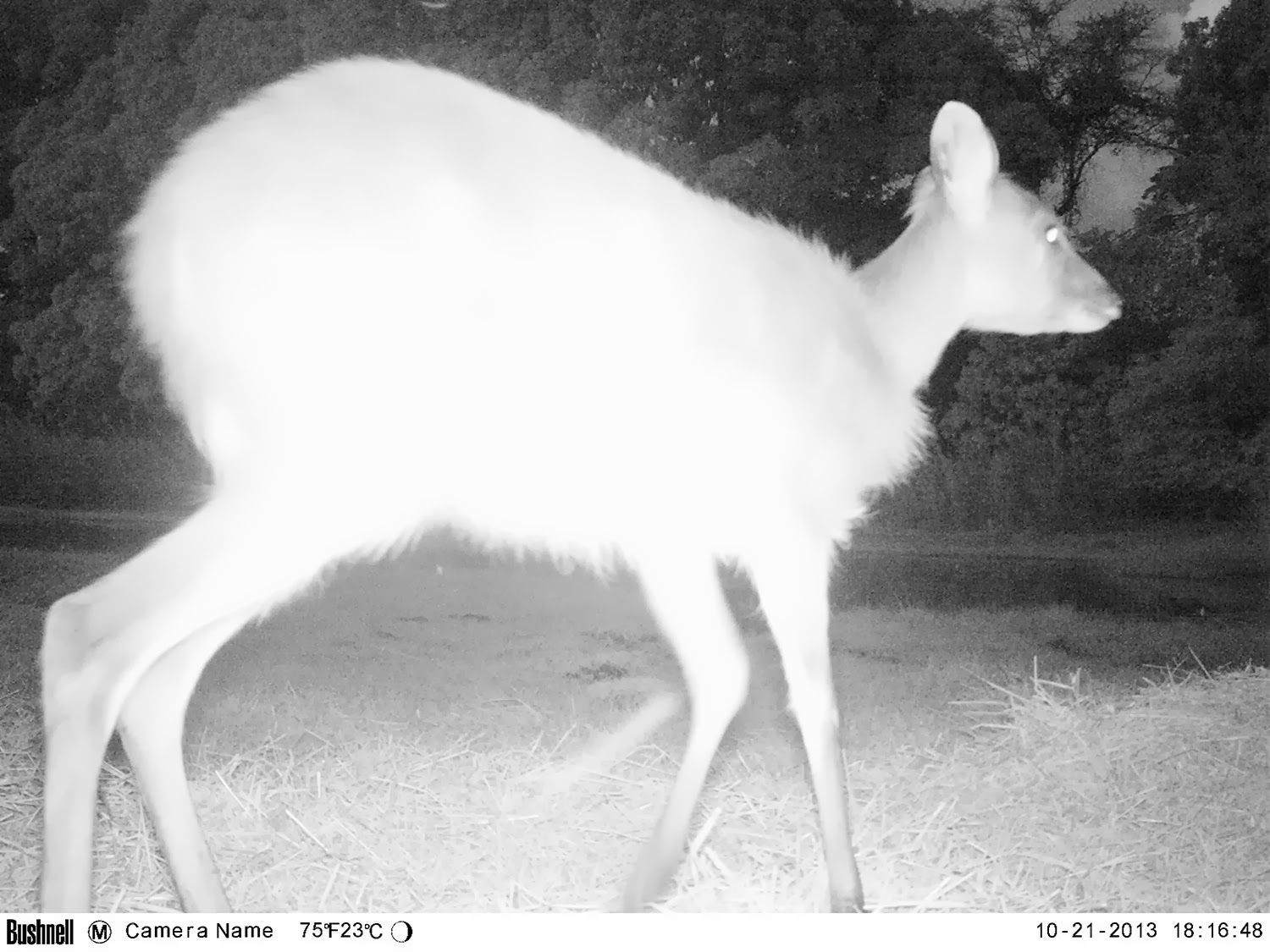 |
| Sitatunga |
 |
| Hippopotamus |
 |
| Hippopotamus. Getting closer! |
 |
| Female Puku |
 |
| Young Puku |
We arrived in Kasanka during the last 10 days of October, which is also just about when the bats start arriving from all over Africa.
I would have waited until later in the year, say mid-November, if I didn't have to be on a plane back to Perth on the 10th.
As a result of our slightly early arrival in Kasanka, bat numbers were nowhere near their peak. However, there were still a lot of bats!
Counting bats leaving the roost in the video footage I gathered, I estimate there were 80,000 Straw-coloured Fruit Bats present whilst we were there. That is an amazing number of Africa's largest bat species, but the mind simply boggles when you realise that this number, eighty thousand, is a mere
one percent of their number at peak season!
Eight million bats must be an incredible sight to behold.
Fibwe Hide is the best known spot for viewing the bats, and this is where we went for the first evening. You can't see the bats leaving the roost from the platform - you see them flying along the swamp towards the feeding grounds.
It was a slow trickle at first, and I was a bit disappointed that there seemed to be few bats. The bats soon started drifting past in huge numbers though.
 |
| The tree which holds Fibwe Hide, and the ladder going to the platform |
 |
| First Straw-coloured Fruit Bat! |
 |
| ...And then more came. |
I have embedded a few videos in this blog post, as photographs just don't do the bats justice.
On Monday (21 Oct) we searched for a good bat watching site during the day. We came across the BBC Platform, which was apparently used by BBC for David Attenborough's documentaries.
It is also, apparently, somewhere that you're not allowed to visit unless you pay for the 'bat experience' tour. In our defense, there was no wooden gate across the road, as there had been in other places, and no sign to indicate this was a restricted platform! The rangers reckon an Elephant messed with the gate during the night (there were indeed Elephant droppings close by).
Anyway, this platform gave excellent views of the bat roost during the day, and I'm sure it would have been amazing to be there at dusk when they left the roost. We chose a nearby spot on the ground to watch them at dusk.
 |
| The core of the bat roost, leaves missing from the trees as a result of many years of too many bats! |
 |
| They hang off the trees like huge bunches of fruit |
 |
| Another stunning sunset, this time from the dambo near BBC platform |
 |
| There was another, rather low, platform near the BBC platform, but it was pretty useless. Maybe when the bats are in full force, the roost overflows into this bit of forest... |
These two videos are of the bats leaving the roost site. These are what I used to get an estimate of numbers. It was strange to see such large numbers of animals, yet they gave out hardly a sound.
On the final evening we watched the sunset from Fibwe Hide, then watched from the swamp below Fibwe as the bats flew over us in their hundreds and thousands.
What an incredible experience it was to see the bats of Kasanka. I look forward to one day seeing them when all eight million are there!
Next post; the birds of Kasanka...
Part four - Kasanka, the Birds
Part five - Mana Pools


