Monday, 25 June 2012

Ringing near Wild Geese Lodge

The area we ringed in is not strictly part of the Wild Geese Lodge Game Park, so we didn't access the ringing spot through there. With our hands full of poles, nets and other ringing equipment, we left the car on the side of the road and walked about 500m (it seemed much further in the dark!) to a grassy area scattered with acacia trees. We set up nets along a couple of the paths, by which time the sun had decided to make an appearance. 
Shortly afterwards, we saw a raptor flying around, shrieking as it did so. Upon closer inspection it turned out to be a Bat Hawk! It showed very well and then landed in a stand of eucalyptus trees, where I later photographed it.

Bat Hawk flying around.
...And in a tree later in the day.
Ringing was not particularly successful, although some nice birds were caught such as Rattling and Red-faced Cisticolas and White-browed Scrub-robins.

Rattling Cisticola
All the action, however, was happening about 20 meters off the ground; Some sort of creeper (I don't know the name) that grows high up in other trees was flowering, and dozens of sunbirds were feasting upon the nectar. Western Violet-backed Sunbird was there, as well as Miombo Double-collared, Variable, White-bellied, Scarlet-chested, Amethyst and a probable Purple-banded Sunbird. Other birds were feeding here too - Weavers, White-eyes, Barbets and Bulbuls just to name a few. I heard a Burnt-necked Eremomela in the acacia trees. I personally saw or heard 55 species that morning, which is not bad for a morning concentrated on ringing.


Thursday, 21 June 2012

Nyanga Ringing June 2012

Maybe winter is not the best time of year to visit one of Zim's coldest places... There were not all that many birds around!

We (the usual group of four ringers, plus a couple of others) stayed in a lovely cottage just around the corner from Troutbeck Hotel in Nyanga. We arrived on Saturday afternoon (16th June) and had nets up for half a day on both Saturday and Monday, plus the whole of Sunday. On the property was a fair bit of forest and two rivers which flowed into a small dam at the bottom of the garden.

The view from the cottage

We left up the poles during the nights, only packing up the nets, in order to hasten the setting up of nets the next morning. Well, I am certainly glad I took gloves with me, as early in the morning the lawn, trees and poles were covered in a thin layer of ice! Perhaps that was why there were so few birds around - they were all frozen...

We did, however, catch some lovely birds. A Mountain Wagtail was caught, and a different one was seen with a ring (Julia had ringed some birds at this spot earlier in the year).  A Yellow-throated Woodland Warbler was also caught, as well as two stunning White-starred Robins. Olive Sunbird, Cape Robin-chat and Cape Batis were among the other species caught.
The White-starred Robins were particularly interesting because according to Irwin's Birds of Zimbabwe these birds vacate the highlands during winter and move to lower elevations - perhaps to escape the cold. Why are these two still in Nyanga in the middle of winter? There must be more still in the area; if not for having caught them we wouldn't have even known they were around.
African Olive-pigeons and White-necked Ravens flew past every day, plus an African Goshawk on one morning. Quite a few eastern highlands 'specials' were seen in the garden including Cape Canary, Stripe-cheeked Greenbul, a few groups of Roberts' Warbler, White-tailed Crested Flycatcher and Livingstone's Turaco. A pair of African Black Duck, which live on a dam further downstream, flew past often.

Male Olive Sunbird. Note the bright yellow pectoral tufts, which the females don't have.
Yellow-throated Woodland Warbler. The smallest bird caught on the trip at 8.5 grams!
Definitely the prettiest bird caught; White-starred Robin
During the moments when we were waiting for an unsuspecting bird to get itself caught, I decided to do something useful; I went looking for other creatures to photograph. I found a few Swynnerton's Reed Frogs, a few lizards and a couple of dead shrews, which may have been victims of the cold conditions.

These lizards were all over the rockery in front of the cottage. Not yet sure what species they are.
A beautiful adult Swynnerton's Reed Frog.
Another frog, which I suspect is the same species as above, but a juvenile, explaining the lack of stripes.
A short walk from the cottage was a waterfall, upon which I decided to practice some long exposure photography. Stupidly, I forgot to take my tripod with, but I managed to make a plan. I sacrificed my gloves to use as a beanbag, of sorts, for the camera! With a shutter speed of 10 seconds, here is the result...


Sunday, 3 June 2012

Ewanrigg and Mukuvisi 2 + 3 June 2012

Ringing at Ewanrigg Botanical Gardens was very slow on Saturday, with few birds caught. Some of the birds caught were unusual, almost making up for the lack of numbers...
Grey-backed Camaroptera was the first bird caught. Later a Southern Black Flycatcher was trapped, with a few birds in between. Feeling quite frustrated we eventually went to pack up the last of the nets, and in them we found the day's best birds! A Green Wood-hoopoe and a Brown-crowned Tchagra.
We only had one net up in the aloes (which were mostly finished flowering), so not many sunbirds were caught.
Southern Black Flycatcher
Brown-crowned Tchagra
One of the sunbirds on dry aloe flower - which species??
White-bellied Sunbird male.
Immature male Scarlet-chested Sunbird.

The monthly walk at Mukuvisi was quite windy and cold - I spent almost as much time looking for patches of sunlight as I spent looking for birds.
White-breasted Cuckooshrike, Southern Hyliota, Groundscraper Thrush, Swallow-tailed Bee-eater, White-crested Helmet-shrike and Miombo Blue-eared Starling were seen, but no Spotted Creeper.
The best sightings were in fact both reptiles. A big Nile Monitor was sunning itself on the path in one spot, and at the picnic site a Schlegel's Blind Snake slithered past whilst we were doing the bird list! It was quite fast and was going through the leaf-litter, so the photo is unfortunately not great.

Schlegel's Blind Snake. This was a first for me.


Saturday, 26 May 2012

Recent Ringing and Birding

I have been quite busy in the last couple of weeks, with a bunch of different birding trips thrown in the mix.

We have had three recent ringing trips - The first was a night-time attempt to catch Three-banded Plovers at Afdis (A success, with 9 TB Plovers caught, 3 of which were re-traps). Also caught was a Kurrichane Thrush, two Laughing Doves and a bat - which is still being identified.

The unidentified bat caught at Afdis. Photo by Erin Murphy
Next was Monavale Vlei, which was not particularly lucrative, and neither was the more recent trip to Mukuvisi Woodland, in attempt to catch some miombo woodland birds. The highlight of the Mukuvisi trip was in fact a Bronze-winged Courser on the dirt road at 5am! I also had a great sighting of a duiker later on in the day.
Mist nets billowing in the wind at Monavale Vlei.
Common Duiker at Mukuvisi.
Other recent birding has been at Haka Park, Domboshava and Borrowdale Brooke.
Haka Park was nice as usual, although we didn't see a great variety of birds. White-throated Robin-chat, Spotted Creeper, Miombo & Southern Black Tits, Swallow-tailed Bee-eater, Malachite Kingfisher and Klaas's Cuckoo were the highlights of the morning at Haka.

I went walking around Domboshava for an afternoon with my dad, where I saw Striped Pipit, Lazy Cisticola, Mocking Cliff-chat, Rock Martin and Cinnamon-breasted Bunting, among other species.

Cinnamon-breasted Bunting
Borrowdale Brooke has had a few unusual birds recently.
3 Three-banded Plovers have been hanging around the muddy edges of the dams recently. Sadly none of them are ringed! I have been making an effort to photograph the waterbirds; mainly coots, moorhens and jacanas and I am particularly pleased with my coot photograph.

Three-banded Plover
Red-knobbed Coot
My garden has seen a bit of action this week with Orange-breasted Bush-shrike and Green-backed Honeybird, both a first for the garden. A Spotted Eagle-owl has been standing on the lawn every night this week and a couple of Barn Owls have flown past.

Green-backed Honeybird

Saturday, 5 May 2012

Haka Park, May 5th

We spent half the morning ringing birds in Haka park and decided to finish early, as we were not catching much. I did a quick drive through the woodlands to try photograph some birds. I hardly saw or heard a bird until I was about to give up, when I stumbled across a bird party containing Cardinal and Bennett's Woodpeckers, Black Cuckooshrike, Southern Hyliota, Stierling's Wren-warbler, Miombo and Southern Black Tits, Green-capped Eremomela, Yellow-throated Petronia and a lovely Spotted Creeper.
Cape and Yellow-throated Longclaws were on the main vlei near the bridge.

Male Bennett's Woodpecker
Miombo Tit
I was lucky to find this Spotted Creeper on a branch right in front of me!

Ringing at Afdis 28 April

One of the first catches of the morning was a Common Waxbill, which pretty much set the tone for the rest of the day. Blue and Common Waxbills, Bronze Mannikins and Jameson's Firefinches made up about half of the birds ringed during the day!
Some more exciting birds were caught, however. Two Black Crakes were caught in spring traps, along with two Bar-throated Apalises in the nets. There were still a few waders around - about 10 Three-banded Plovers (caught one), four Blacksmith Lapwings (caught one), 25 African Wattled Lapwings and 3 Wood Sandpipers (caught one).
Three-banded Plover
Blacksmith Lapwing
Bar-throated Apalis
The other good catch was a young Dark-capped Yellow Warbler with strange primary moult.

Starting from the outer primary, working inwards: 3 old feathers, 1 pin, 1 half-emerged and 4 feathers successfully moulted.
The inner primary, instead of being in the same state as the four on its right, is also half-emerged.
It would be interesting to have caught it a week later, to see the changes...


Thursday, 26 April 2012

A week in the Chimanimanis

I recently spent a night in the Chimanimani area, after which I wrote that I would love to spend more time there. Well, less than a week later I was back in the area! I arrived on the 13th and left on the 20th of April. For the first half of the week I was busy being the official photographer for an Outward Bound instructor selection course. During this time I did not get much birding done as the schedule was pretty tight.
I did, however, stay a couple of days extra at Outward Bound so that I could spend a bit of time looking for birds.

Miombo Rock-thrush female
In the 'gardens' around the houses and dorms there were a fair few birds, many of which were fairly accustomed to people. Miombo Rock-thrush was the main performer here, with a family of three seen regularly and providing me with great photo opportunities. Familiar Chat were also quite easy to find in the gardens. Plenty of waxbills, mannikins and whydahs were around, but no Green Twinspot this time. A flowering bottle-brush tree attracted many sunbirds; Miombo Double-collared, Variable, Collared, Amethyst and even Western Violet-backed Sunbirds made an appearance. A Red-faced Crombec spent a short time in one of the trees in the garden - a bird I had never seen before. A Blue-spotted Wood-dove was sitting on the lawn one afternoon!
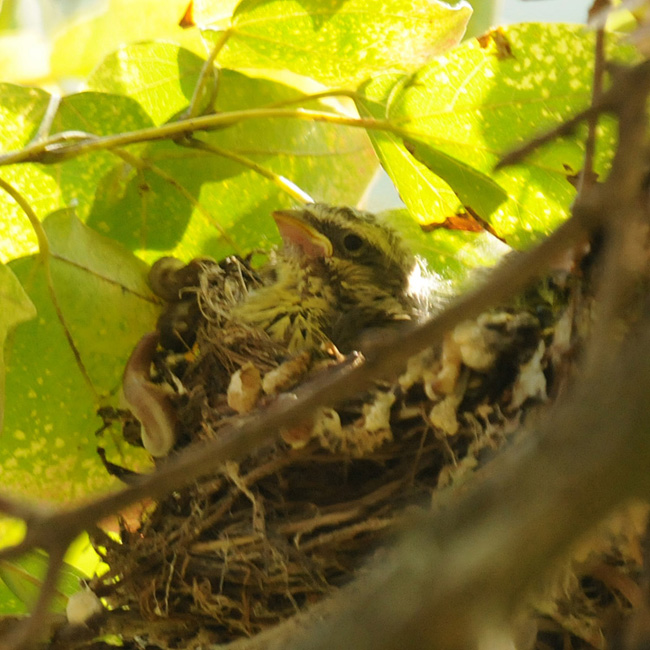
The day before I left I noticed a small nest on a branch hanging over the roof of my car. It was low enough that I could stand on the roof of the car and see inside (just!). It turned out to have small chicks inside; Yellow-fronted Canaries.
Yellow-fronted Canary chick in nest
Brown-hooded Kingfisher

Birding in the Miombo woodlands was, for a change, a real joy. The hilly terrain meant that I could be at the same level as part of the canopy, instead of being dwarfed by the trees as far the eye could see, as is usual in Harare woodlands. This meant nice backgrounds for photographs! The birds were quite exciting too; Red-faced Crombec, Southern Hyliota, White-breasted Cuckooshrike and Miombo and Cinnamon-breasted Tits were seen most days, plus Striped Pipit and Green-backed Honeybird were seen twice each.

The Miombo woodlands - mostly Mountain Acacia and Muzhanje trees
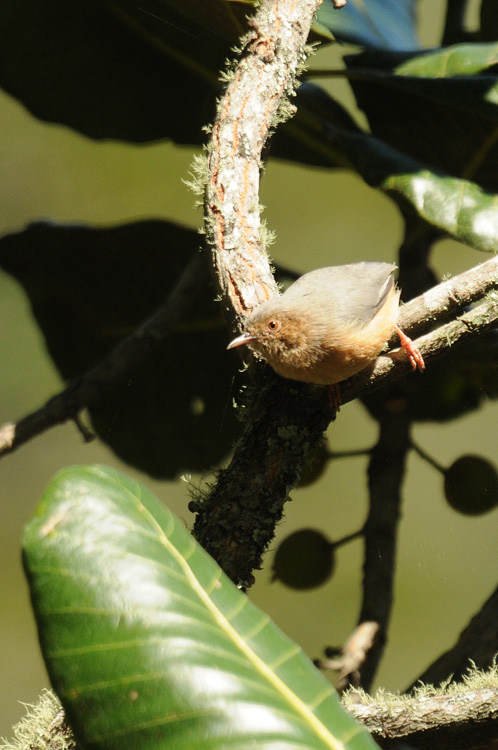
Red-faced Crombec
Green-backed Honeybird
Cinnamon-breasted Tit
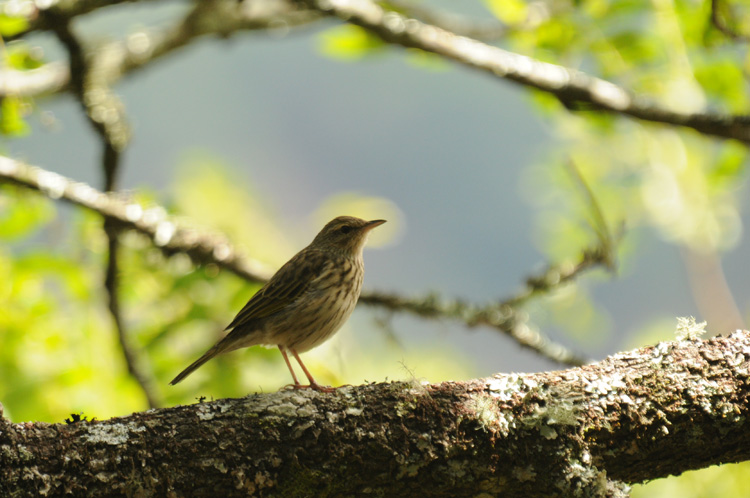
Striped Pipit

The other main habitat was riverine woodland and thicket. Quite a few small rivers flow past the area, and there are nice patches where thicket meets Miombo woodland, creating an interesting mixture of birds.
Dark-backed Weaver, Cape Batis, White-tailed Crested-flycatcher, Olive Sunbird, Stripe-cheeked and Yellow-streaked Greenbuls, White-eared Barbet, Yellow-rumped Tinkerbird, African Firefinch, Livingstone's Turaco, Scaly-throated Honeyguide, Tambourine Dove and Square-tailed Drongo were some of the more exciting birds of these riverine habitats. Near Tessa's Pool I photographed a Mountain Wagtail on the boulders by the river's edge. In one thicket I saw three species of Apalis; Bar-throated, Yellow-breasted and Chirinda Apalises.

Chirinda Apalis, endemic to the eastern highlands of Zim and adjacent Mozambique.
Mountain Wagtail
White-eared Barbet
As far as other wildlife was concerned there was not much about. Other than Baboons, the only mammals I saw were a pair of Klipspringer and a Mutable Sun Squirrel.
One exciting find was a lizard which I believe to be a Chimanimani Flat Lizard, confined to (you guessed it!) the Chimanimani area.

Chimanimani Flat Lizard - I think!
Other than that, the scenery was gorgeous, and I have added a couple of photos to prove it.